These are a series of projects I did for a course in an autism spectrum disability certificate program course I am taking. The purpose is creating training that provided visual support to teaching a behavior in the workplace.
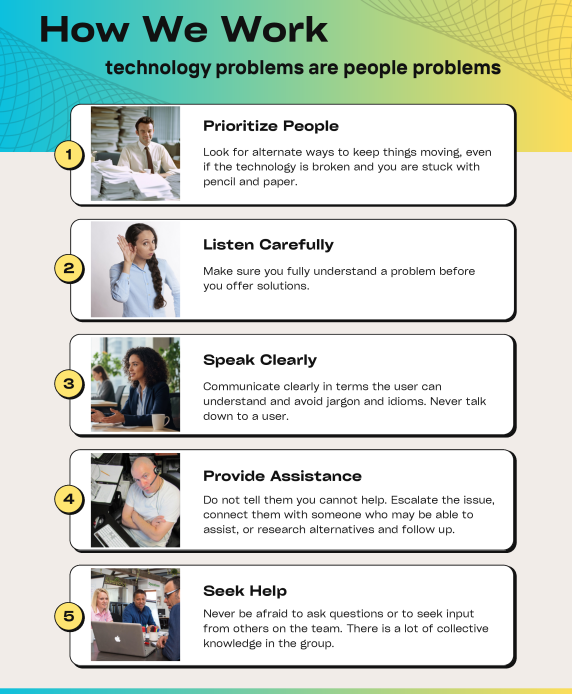
The How We Work teach new skills flyer is designed to provide a visual guide assisting support staff in learning and building a practice of basic customer support skills in a professional setting.
Problem statement: In the technical support function, employees are often hired because of their strong technical skills. Since strong technical skills are prevalent in the neurodiverse community (Ries 2005), customer service, or soft skills, are often lacking.
This visual support was developed to create a simplified path to teach employees the basics soft skills necessary to provide a positive support engagement with the customer. (social/emotional support, and communication support). Improving the employees’ customer service skills will ultimately improve the organization’s ability to provide exemplary customer service (organizational support).
This visual support in the form of a printed flyer uses both picture support and written word level representation to lay out five basic tenants of customer service, keep work flowing to minimize downstream impacts; listen carefully to fully understand a problem; then communicate your recommended solutions clearly (or as Stephen Covey put it “seek first to understand and then to be understood”); while always assisting the customer even if you do not have a direct solution to the problem; and finally reminding the employee that they are part of a larger team that can assist them in their work.
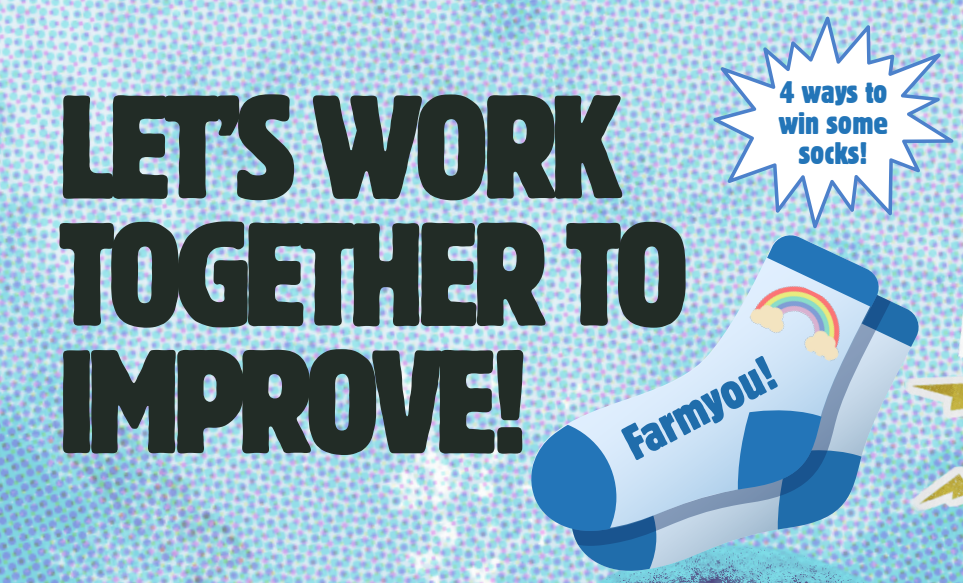
The Help Us Improve incentive chart was created to promote a culture of continuous improvement and teamwork in the workplace.
Problem statement: Building a culture of engagement can be difficult when working with a population of neurodiverse employees, as is often the case in technical workplaces. Neurodiverse individuals, especially those with ASD and/or anxiety disorder, find it difficult to express their ideas for improvement and both give and receive praise.
This visual support was developed to encourage engagement in workplace improvement through the sharing of ideas and both giving and receiving praise (social/emotional support, and communication support). It also includes the ability to receive reward for meeting workplace performance goals (organizational support).
This visual support, in the form of a poster, uses both picture support and written word level representation to encourage employees to share their ideas for process improvement and thank their teammates by submitting ideas and kudos via email. It also includes the ability to receive credit for meeting key performance indicators, allowing employees to have the opportunity to be rewarded, even if they didn’t have an idea or thanks to share in a particular week. The program also includes object level support in the form of a reward, a pair of socks and a chance to win lunch.
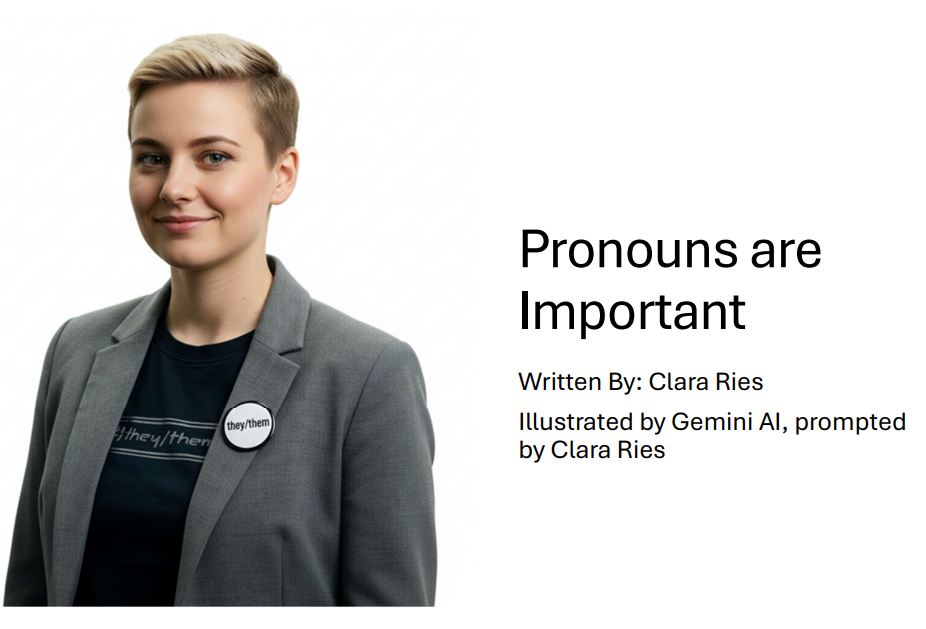
The Pronouns are Important social narrative strategy was created to assist employees with the behavioral change required to accept and begin using other people’s correct pronouns.
Problem statement: Pronouns can be hard for some people. We are accustomed to making assumptions and calling people “she” or “he” even when we are not certain or if someone has expressed their pronouns.
This social narrative is based on typical office motivational posters that can be used outside of the narrative presentation that would be used in booklet form. It is designed to provide flexibility, with each individual image able to stand alone, be incorporated into other material, or distributed as a booklet or flyer.
With both symbol/picture support and written word, this work is set as if it were presented by a member of the transgender community who uses they/them pronouns. It is meant to feel personal and inspire thought about the topic.
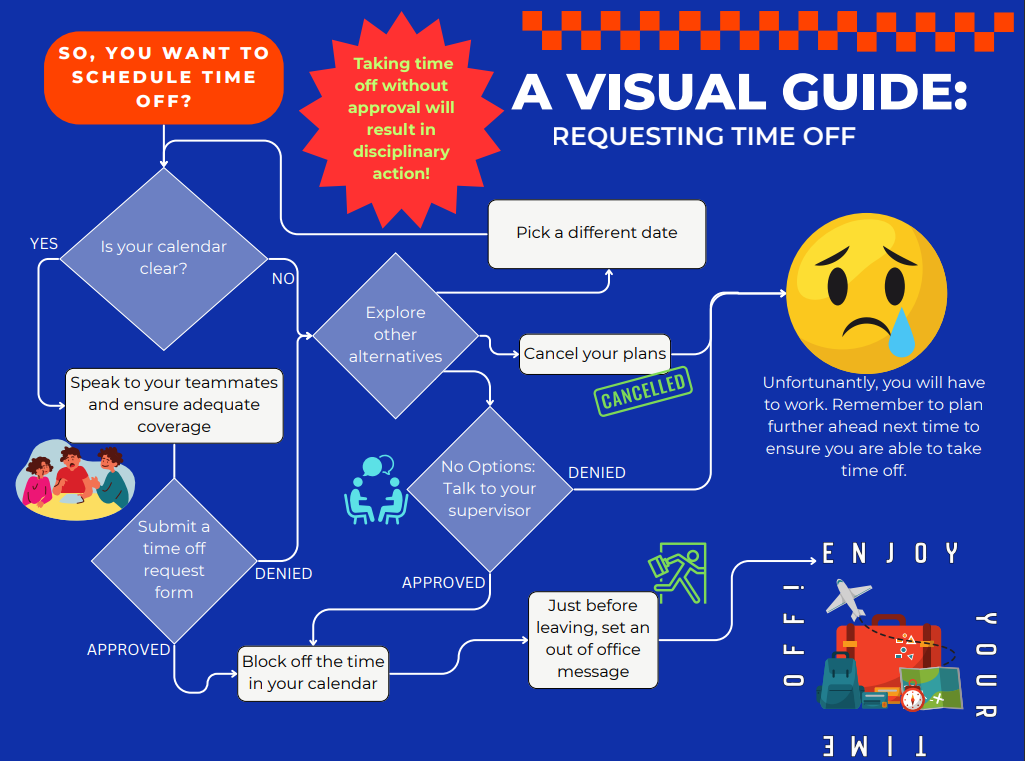
The Visual Guide to Requesting Time Off decision tree was created to assist employees with the steps required to take planned time off.
Problem statement: Due to the number of people employed in the information technology sector who exhibit some level of neurodiversity such as autism, ADHD, and anxiety, following the expected process can be difficult. The observed issues include:
– Failure to request time off ahead of time
– Lack of communication with their teammates prior to requesting vacation
– Reluctance to talk to their supervisor if they need the time off, but it was denied
– Forgetting to submit the time off request form (separate from time off reporting in Workday)
– Not blocking their calendar
– Forgetting to set an out of office message
This visual support was developed to remind employees of the expected steps in the process, some of which are informal. With both symbol/picture support and written word level representation, the graphic is intended to make the workflow obvious, make expectations clear, and reduce ambiguity in the current process. This is expected to result in a higher level of compliance for all employees, but more specifically those who are neurodivergent. Graphics were selected to highlight the need for conversation where that is expected, to reflect the need to be proactive, and consequences of not following the process.